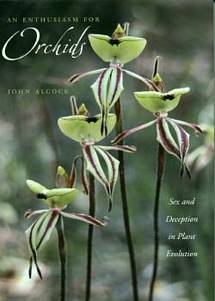

An Enthusiasm for Orchids: Sex and Deception in Plant Evolution

Original price was: £44.49.Current price is: £43.00.

Usually dispatched within 4-7 days

An Enthusiasm for Orchids: Sex and Deception in Plant Evolution Author: Format: Hardback First Published: Published By: Oxford University Press Inc
string(3) "320"
Pages: 320 Illustrations and other contents: Numerous colour photographs, line drawings ISBN: 9780195182743 Categories: ,

302pp, colour photos. The evolutionary story as told through the orchid family, mainly with reference to Australian native orchids. Shows how orchids have adapted in intricate and varied ways, developing resourceful tricks for reproduction; through an entertaining field trip diary and personal comment, touches on many aspects of plant biology, biodiversity, taxonomy and conservation. A good read. Hardback.

019518274X

Weight0.8 kg
Author

Editor
Photographer
Format

Illustrators
Publisher

An Enthusiasm for Orchids: Sex and Deception in Plant Evolution is ... an interesting book, [that] can provide good examples of plant adaptations which are desperately needed in these sort of classrooms which tend to focus more often on animal examples. * Erik Rothacker, Plant Science Bulletin Vol 53(1) 2007 * The book is easy to read and has many beautiful illustrations. * Sebsebe Demissew, Nature * For an overview of the concepts of adaption and maladaption, a brief history of evolution in general, and a good look at the hotsots, biodiversity and conservation of orchids in southwestern Australia in particular, this is the book to read. * Sebsebe Demissew, Nature * ...presents complex floral characters in an understandable and attractive way. For an overview of the concepts of adaptation and maladaptation, a brief history of evolution in general, and a good look at the orchids in southwestern Australia in particular, this is the book to read. Nature, Vol. 442

Author Biography

Dr. Alcock's research deals with the evolution of diversity in insect mating systems. He studies selected species of desert insects in Arizona and Western Australia, in an attempt to document the variety of male mate-locating techniques in various bees, wasps, butterflies, dragonflies, and other insects. The goal of his research is to test hypotheses on the adaptive value of the different ways in which males find mating partners.